Table of Contents
Air Quality as Baseline Health
Pet wellness content increasingly focuses on air quality, often positioning HEPA filters as mandatory for responsible pet ownership. That's overselling.
Air quality matters. Pets breathe the same indoor air you do. Poor air quality affects their respiratory health, skin health, and overall comfort. But improving air quality doesn't require $300 air purifiers or obsessive monitoring.
Multiple small changes add up: increasing humidity (dry air irritates airways), growing air-purifying plants, using natural materials that off-gas fewer chemicals, and ensuring adequate ventilation.
This isn't about creating a sterile environment. It's about baseline improvements that make breathing easier for both you and your pet.
The Humidity Factor
Winter indoor air is dry. Heating systems reduce relative humidity to 20-30%, well below the comfortable 40-50% range. Dry air irritates mucous membranes, triggers respiratory issues, and dries out skin.
Pets with flat faces (Persian cats, Bulldogs, Pugs) struggle more in dry air. Their compressed airways are already challenged. Dry air makes breathing harder.
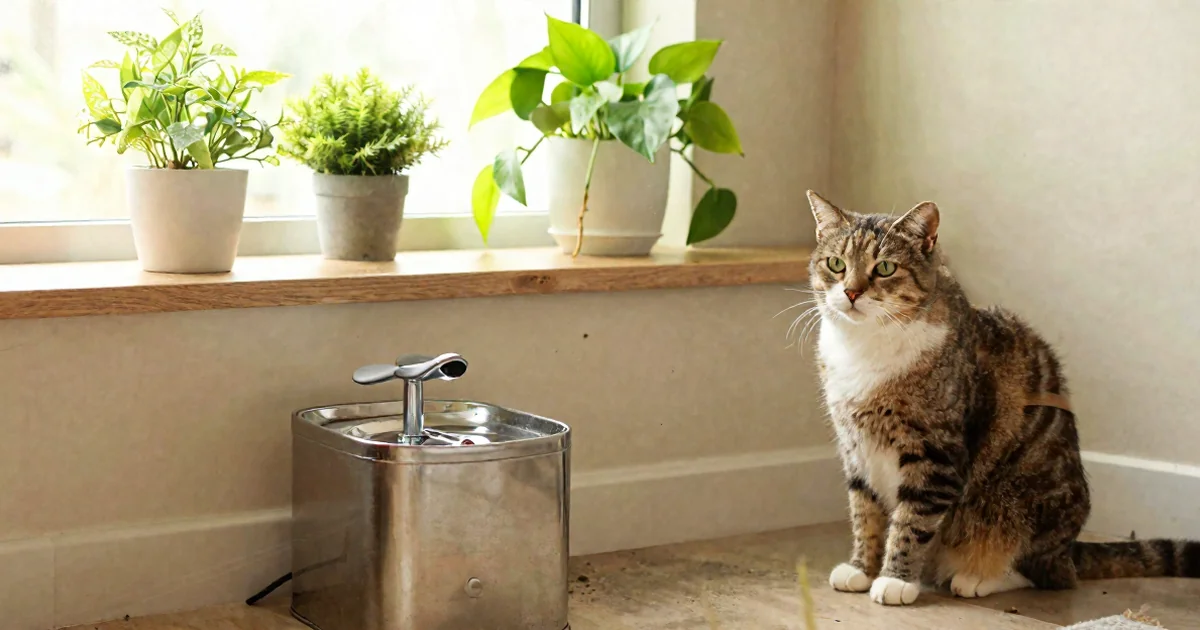
The simplest humidity boost: water features. A pet water fountain naturally evaporates water into the surrounding air, increasing local humidity.
Budget option: Stouchi Stainless Steel Pet Water Fountain
85oz capacity, food-grade stainless steel, eco-friendly materials, ultra-quiet pump, 7-stage filtration.
Price: $30-40.
Why this works: You're buying a water fountain for hydration anyway. It doubles as a humidity source. Evaporation from the fountain's surface and flowing water adds moisture to dry air.
Stainless steel matters here. Plastic fountains off-gas chemicals (that "new plastic" smell). Stainless steel doesn't. Better air quality starts with reducing chemical sources.
Larger capacity option: Petbank Stainless Steel Cat Water Fountain
108oz (3.2L) capacity, water level window, low water sensor, easy cleaning.
Price: $40-52.
Why larger capacity: More surface area means more evaporation. Also requires less frequent refilling (helpful for busy households).
Air-Purifying Plants (With Light Support)
Certain plants naturally filter air by absorbing volatile organic compounds (VOCs) through their leaves and roots. NASA studied this extensively for space station applications.
Effective air-purifying plants:
- Pothos: Filters formaldehyde, benzene, xylene
- Snake plants: Filters formaldehyde, converts CO2 to oxygen at night
- Spider plants: Filters carbon monoxide, formaldehyde
- Philodendron: Filters formaldehyde
- Peace lily: Filters ammonia, benzene, formaldehyde (toxic to cats and dogs if ingested - keep out of reach)
One plant doesn't dramatically improve air quality. NASA found you need roughly 1 plant per 100 square feet for measurable effect. That's 10-12 plants for a 1,000 square foot apartment.
Growing that many plants in winter requires supplemental light. FECiDA 3-Pack Clip Grow Lights help plants stay healthy and actively filter air even during low-light months.
Price: $25-35 for three lights.
Clip lights to shelves around your home. Position plants under lights. Run lights 10-12 hours daily. Plants photosynthesize actively, filtering more air than dormant plants.
Propagating More Air-Purifying Plants
Buying 10-12 plants costs $80-180 at nurseries. Propagating them costs $20-40 in supplies.
KAXYEW Plant Propagation Station holds 5 cuttings at once. Take cuttings from one pothos plant. Root them in the station. Within 4-6 weeks, you have 5 new pothos plants.
Price: $16-22.
Repeat this with different air-purifying plants. Over 3-4 months, propagate enough plants to fill your home. Total cost: one propagation station plus one grow light for faster rooting.
This is cheaper than buying plants and increases air purification capacity significantly.
Natural Materials Over Plastic
Plastic off-gases chemicals (VOCs) especially when new or heated. That "new plastic smell"? Those are chemicals evaporating into your air.
Pet supplies often use plastic: food bowls, storage bins, litter boxes, toy bins. Switching to natural materials reduces off-gassing.
Deosur 4-Pack Bamboo Storage Baskets store pet supplies (food, treats, toys, grooming tools) without plastic off-gassing.
Price: $28-35 for four baskets.
Bamboo is naturally antimicrobial and breathes better than plastic. It doesn't trap odors. Pet food stored in bamboo baskets smells less than food in plastic bins.
This isn't a dramatic air quality improvement. It's a small reduction in chemical exposure. Multiple small reductions add up.
Ventilation Matters More Than You Think
The single most effective air quality improvement: opening windows.
Indoor air in winter contains 2-5x more pollutants than outdoor air because heating systems recirculate stale air without bringing in fresh air. Even in cold climates, cracking a window for 10-15 minutes daily flushes out stale air.
Pet-specific air quality issues ventilation addresses:
- Litter box odors: Concentrated ammonia irritates respiratory systems. Ventilation dilutes it.
- Dander buildup: Pet hair and dander circulate in stagnant air. Fresh air reduces concentration.
- Food odors: Wet pet food smells accumulate in closed homes. Ventilation clears it.
You don't need to leave windows open all day. Ten minutes in the morning, ten minutes in the evening. That's enough to exchange most indoor air.
When HEPA Filters Make Sense
HEPA filters aren't necessary for every pet owner. They make sense in specific situations:
You or your pet has respiratory issues: Asthma, chronic bronchitis, allergies. HEPA filters measurably reduce airborne irritants.
You live in high-pollution areas: Near highways, industrial zones, or wildfire-prone regions. Outdoor air quality is genuinely poor.
You have multiple pets: Three or more cats/dogs generate significant dander and odor. HEPA filters help.
You can't ventilate easily: Basement apartments, high-rise buildings with sealed windows, or extreme climates where opening windows isn't practical.
If none of these apply, plants + humidity + ventilation + natural materials probably suffice.
If you do need a HEPA filter, buy one sized appropriately for your room (check square footage ratings). Run it continuously in the room where pets spend most time.
The Multi-Factor Approach
No single tool fixes air quality. Combinations work better:
- Water fountain (humidity + hydration)
- Air-purifying plants (VOC filtration + oxygen)
- Grow lights (keep plants actively filtering in winter)
- Natural materials (reduce off-gassing sources)
- Daily ventilation (flush stale air)
Total cost for all five:
- Water fountain: $30-50
- Propagation station + 3 starter plants: $30-50
- Clip grow lights: $25-35
- Bamboo storage: $28-35
- Ventilation: Free
Total: $113-170
Compare that to a quality HEPA air purifier: $200-400 plus $50-100 annually in replacement filters.
The multi-factor approach costs less upfront and has lower recurring costs (no filter replacements). It also provides multiple benefits (humidity, hydration, aesthetics, plant propagation) instead of only filtering air.
What Actually Works
Air quality improvements you can measure:
- Reduced dust buildup: Check surfaces after 2-3 weeks. Less dust means better filtration.
- Less pet odor: If litter boxes or pet bedding smell less strong, ventilation and humidity are working.
- Fewer respiratory issues: Pay attention to sneezing, coughing, wheezing in both you and your pet. Reduction indicates improvement.
- Better sleep: Dry, stale air disrupts sleep. Humid, fresh air helps both pets and humans sleep better.
Things you can't easily measure:
- VOC levels (requires specialized equipment)
- Particulate counts (requires air quality monitors)
- Long-term health outcomes (too many variables)
Focus on the measurable changes. If dust decreases and odors reduce, air quality is improving even if you can't quantify exact numbers.
Starting Simple
You don't need all five interventions immediately. Start with the easiest:
Open windows daily for 10-15 minutes. Free. Immediate impact.
Add a water fountain. You're probably buying one anyway for hydration. Choose stainless steel instead of plastic.
Buy one air-purifying plant. Pothos or snake plant. Place near where your pet sleeps.
Those three changes cost under $50 total and address 70% of common air quality issues.
Add plants and grow lights later if you want more filtration capacity. Add bamboo storage if plastic off-gassing bothers you.
But start with ventilation and humidity. Those make the biggest difference for the least effort.
Disclaimer: Pets with pre-existing respiratory conditions require veterinary care. Air quality improvements supplement medical treatment but don't replace it. Consult your vet for pet-specific health concerns.
TopicNest
Contributing writer at TopicNest covering lifestyle and related topics. Passionate about making complex subjects accessible to everyone.