Table of Contents
The Low-Stakes Approach to Free Plants
Growing plants from cuttings is one of those activities where perfectionism gets in the way of results. You snip a stem, stick it in water, and wait 2-4 weeks. Some root, some don't. The ones that work become free plants.
Most propagation guides make this sound technical. They list exact light requirements, rooting hormone ratios, and humidity percentages. That's useful if you're propagating rare orchids. For pothos, coleus, or basil? You need a jar of water and decent light.
The reality: roughly half your cuttings will root successfully. That means if you propagate 10 cuttings, you'll get 5 new plants. That's still 5 free plants you didn't have before.
Why February Works for Propagation
February is scientifically ideal for propagation, which sounds counterintuitive given the low natural light. But plants respond to stress by focusing on root development rather than leaf growth. Winter light is low enough to trigger rooting without burning tender new growth.
You're also stuck indoors with time to check on things. Propagation requires changing water weekly and monitoring for algae or rot. That's easier when you're home regularly.
The timeline: most cuttings root in 2-4 weeks during winter months. Faster-rooting plants (pothos, philodendron, tradescantia) might show roots in 10-14 days. Slower plants (succulents, woody herbs) can take 6-8 weeks.
Building a Basic Propagation Station
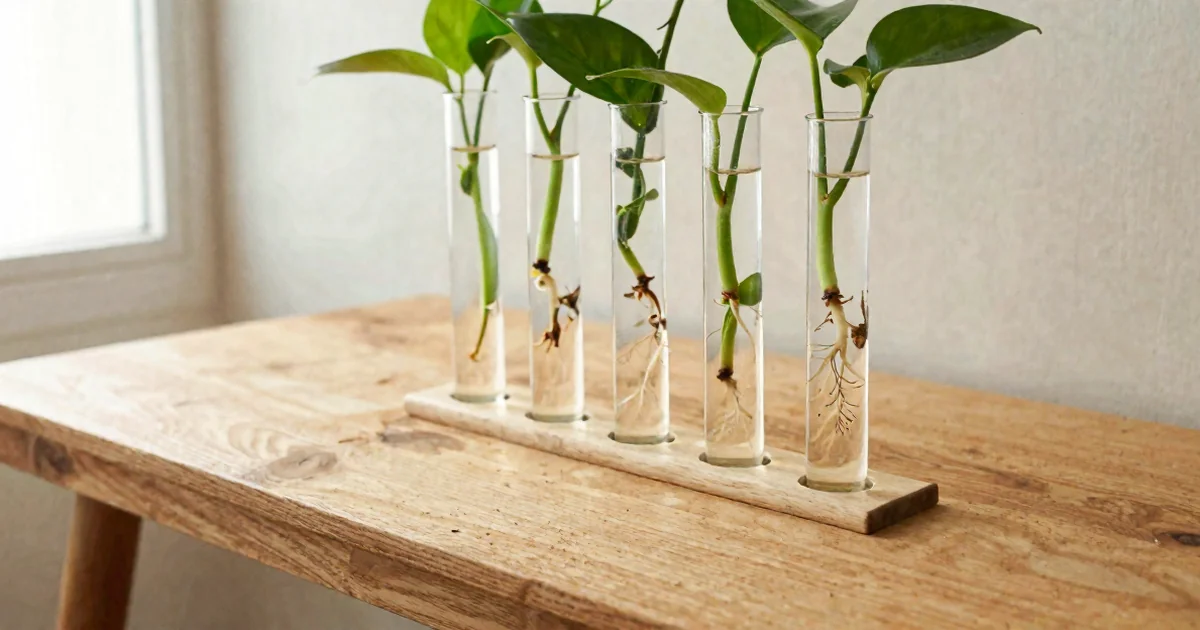
A propagation station is just a container that holds water and cuttings upright. The simplest version is a mason jar. The upgraded version uses a wooden stand with multiple glass tubes so you can propagate several cuttings at once.
Option 1: All-in-one setup
The KAXYEW Plant Propagation Station includes 5 glass test tubes in a wooden base. It sits on a desk or shelf and holds 5 different cuttings. You fill each tube with filtered water, drop in a cutting, and change the water weekly.
Price: $16-22. That's roughly $3-4 per propagated plant if all 5 root successfully.
Option 2: Add light for winter
If you're propagating in a room with limited natural light (common in February), clip-on grow lights speed up rooting. The FECiDA 3-Pack Clip Grow Lights attach to shelves or desks with adjustable gooseneck arms.
They include timers (4/8/12 hour settings), so you set it once and forget it. The light runs automatically. Price: $25-35 for three lights.
You don't need this if your propagation station sits near a bright window. But if you're impatient (most of us are), supplemental light cuts rooting time by roughly 30-40%.
Preventing Common Problems
The two main propagation failures are algae growth and root rot. Both come from water quality issues.
Algae: Forms when water sits exposed to light for too long. Green slime coats the glass and clogs developing roots. Solution: cover your propagation containers loosely with breathable material.
Bee's Wrap Beeswax Food Wraps work well here. These are reusable organic cotton wraps coated in beeswax and plant oils. You can drape one over your propagation jar to block light from hitting the water while still allowing air circulation.
Price: $19-25 for a 3-pack (small, medium, large). They last roughly one year with regular washing, then compost when worn out.
Alternative: Modfamily Silicone Stretch Lids stretch over jars and containers. The 7-pack includes sizes from 3 to 10 inches, covering everything from espresso cups to mixing bowls. Use these to seal propagation water stored in the fridge (filtered water lasts longer when cold).
Price: $12-16 for 7 lids that last 5+ years.
Root rot: Happens when water gets stagnant or contaminated. Change water every 5-7 days. Use filtered or distilled water if your tap water is heavily chlorinated.
Organizing Your Propagation Supplies
Once you start propagating regularly, you accumulate small tools: scissors for taking cuttings, plant markers for labeling varieties, rubber bands for securing leggy stems, and pebbles for stabilizing cuttings in water.
Storing these in a plastic bin works, but looks cluttered on a desk or shelf. Deosur 4-Pack Bamboo Storage Baskets hold propagation supplies in natural woven containers with removable washable liners.
Price: $28-35 for four baskets. They stack or sit side-by-side on shelves. Natural bamboo lasts longer than plastic and looks intentional instead of chaotic.
What to Propagate First
Start with plants that root easily and tolerate mistakes. These are the "hard to kill" options:
- Pothos: Roots in 10-14 days. Cut below a node (the bump where leaves attach). One 6-inch cutting becomes a full plant in 6-8 weeks.
- Philodendron: Similar to pothos. Heartleaf varieties root fastest.
- Tradescantia (Wandering Jew): Roots in 7-10 days. Grows aggressively once potted.
- Coleus: Colorful foliage. Roots in 14-21 days. Needs bright light.
- Basil and mint: Edible herbs root in 10-14 days. Harvest leaves while they root.
Avoid succulents for your first attempt. They require different propagation methods (leaf propagation, not stem cuttings) and take 6-12 weeks to root.
The Actual Process
Choose a healthy stem. Look for new growth without flowers or buds. Flowering stems focus energy on blooms, not roots.
Cut below a node. Nodes are the bumps on stems where leaves grow. Roots emerge from nodes, not random stem sections.
Remove lower leaves. Strip leaves from the bottom 2-3 inches of stem. Submerged leaves rot and contaminate water.
Place in water. Fill your propagation station with filtered water. Submerge the bottom 2 inches of stem.
Wait. Change water every 5-7 days. Check for roots after 2 weeks.
Pot when roots reach 2-3 inches long. Younger roots transplant more easily than long, tangled roots.
That's it. The process is genuinely simple. The waiting is the hard part.
When Cuttings Fail
Some cuttings turn brown and mushy instead of rooting. This is normal. It doesn't mean you did anything wrong.
Common reasons for failure:
- Old stem tissue: Woody, mature stems root slower than young green growth.
- Contaminated water: Change water more frequently if you see cloudiness.
- Wrong season: Some plants propagate best in spring/summer, not winter.
- Bad luck: Sometimes cuttings just fail.
If a cutting turns brown, remove it immediately. It can contaminate other cuttings in the same water.
Try again. Take 3-5 cuttings of the same plant. At least one will probably root.
The Math on Free Plants
One propagation station holds 5 cuttings. If 3 root successfully (60% success rate, which is realistic), you've grown 3 free plants for the cost of water and time.
Compare that to buying 3 small potted plants at a nursery: roughly $12-18. Your propagation station paid for itself in one batch.
Over one year, propagating just one batch per month produces 36 free plants (assuming 60% success rate). Even if you give half away, that's 18 new plants without spending money on nursery stock.
Starting Small
You don't need a dedicated propagation corner to try this. Start with one jar on a windowsill. Take 3 cuttings from a plant you already own. Change the water weekly.
If it works, you've learned the skill. If it fails, you've lost 15 minutes of effort and one stem cutting. The plant will grow back.
Propagate what you already have before buying new plants. Most houseplants propagate easily from stem cuttings. You're sitting next to free plants right now.
Disclaimer: Plant propagation success rates vary by species, season, and growing conditions. Research species-specific requirements before propagating rare or expensive plants. This article provides general guidance for common houseplants.
TopicNest
Contributing writer at TopicNest covering lifestyle and related topics. Passionate about making complex subjects accessible to everyone.