Table of Contents
Why February Is Ideal for Propagation
Most plant content treats propagation as a spring/summer activity. More light equals faster growth, right?
That's true for established plants. For propagation, lower light actually helps. Here's why:
Plants respond to stress by prioritizing survival. When you take a cutting, you've severed it from its root system. The cutting experiences water stress. In high light, it also experiences transpiration stress (losing water through leaves faster than it can absorb through developing roots).
Low winter light reduces transpiration stress. The cutting loses less water while roots develop. This increases rooting success rates, especially for beginners.
February offers another advantage: you're home more. Propagation requires weekly water changes and monitoring for rot or algae. That's easier when you're not traveling or spending long days outside.
The timeline: most cuttings root in 2-4 weeks during winter. Faster than summer propagation? No. But success rates are higher, which matters more when you're learning.
Building a Complete Propagation Setup
A functional propagation station needs four components:
- Containers for water and cuttings
- Light source (optional but helpful in low-light rooms)
- Supplies for preventing algae and organizing tools
- Storage for rooted cuttings during transition to soil
Total cost: $80-110 for a complete setup that handles 10-20 cuttings simultaneously.
Component 1: All-in-One Propagation Station
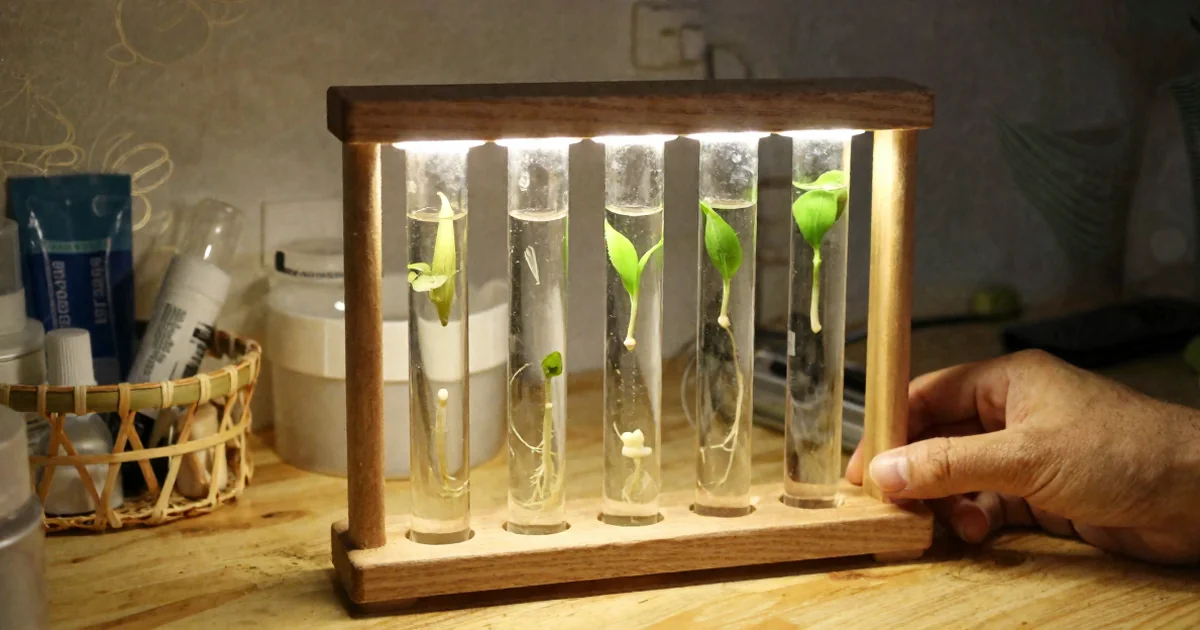
Lightalent Plant Propagation Station with LED combines containers and light in one product.
Includes:
- Wooden stand (sustainable bamboo)
- 4 glass tubes for water propagation
- Integrated 9-level dimmable LED strip
- Height adjustable design
Price: $35-48.
Why this works: Everything needed in one purchase. No assembly of separate components. Plug it in, fill tubes with water, add cuttings.
The dimmable LED matters. Bright lights aren't always better for propagation. Dim setting (level 3-5 out of 9) provides enough light for root development without triggering excessive leaf growth (which stresses the cutting).
Limitation: Holds only 4 cuttings at once. If you're propagating more, you'll need supplemental containers (mason jars work) or a second station.
Component 2: Supplemental Clip Lights
If you're propagating more than 4 cuttings - and you probably will be, since propagation is addictive - add clip lights for overflow jars.
FECiDA 3-Pack Clip Grow Lights attach to shelves or desks near mason jars filled with cuttings.
Price: $25-35 for three lights.
Each light covers 12-18 inches, enough for 2-4 small propagation jars. Three lights handle 6-12 additional cuttings beyond the main station.
With one Lightalent station (4 cuttings) plus three clip lights (12 cuttings), you can propagate 16 cuttings simultaneously. That's 8-12 new plants assuming 60-70% success rate.
Component 3: Algae Prevention and Storage
Algae forms when light hits water for extended periods. Green slime coats glass and clogs developing roots. Two solutions:
Option 1: Beeswax wraps
Bee's Wrap Beeswax Food Wraps - 3-pack with various sizes.
Drape loosely over propagation jars to block direct light from hitting water while allowing air circulation. The wraps are breathable (not airtight), preventing anaerobic conditions that cause root rot.
Price: $19-25.
Bonus use: After cuttings root and you've potted them, use beeswax wraps to cover leftover filtered water stored in the fridge (filtered water lasts longer when cold).
Option 2: Silicone lids
Modfamily Silicone Stretch Lids - 7-pack covering multiple sizes.
Once cuttings develop roots (2-3 inches long), they need transplanting to soil. But sometimes you're not ready to pot immediately (no potting mix available, no pots, etc.).
Silicone lids seal containers holding rooted cuttings, keeping them moist during the 1-2 week transition period between rooting and potting.
Price: $12-16.
These also work for general kitchen use (zero waste swaps), making them multi-purpose purchases.
Component 4: Tool Organization
Propagation accumulates small supplies:
- Scissors or pruners for taking cuttings
- Plant markers for labeling varieties
- Rubber bands for securing leggy stems
- Small pebbles for stabilizing cuttings in water
- Rooting hormone powder (optional)
Deosur 4-Pack Bamboo Storage Baskets organize these tools near your propagation station.
Price: $28-35.
Why bamboo: Natural materials don't off-gas like plastic. If your propagation station sits on a desk or shelf in a living space, bamboo looks intentional instead of cluttered.
One basket holds cutting tools, one holds markers and labels, one holds pebbles and supports, one holds rooted cuttings waiting to be potted.
The Complete Setup Cost
Minimum setup (handles 4-8 cuttings):
- Lightalent propagation station with LED: $35-48
- Bee's Wrap or silicone lids: $12-25
- Total: $47-73
Expanded setup (handles 16-20 cuttings):
- Lightalent propagation station: $35-48
- FECiDA 3-pack clip lights: $25-35
- Beeswax wraps: $19-25
- Silicone lids: $12-16
- Bamboo storage baskets: $28-35
- Total: $119-159
You don't need the expanded setup initially. Start with the minimum. If you propagate successfully and want to scale up, add components over time.
What to Propagate in February
Easy winter propagation plants (high success rates for beginners):
Pothos: Cut below a node (the bump where leaves attach). Strip lower leaves. Place in water. Roots appear in 10-14 days.
Philodendron: Heartleaf varieties root fastest (7-14 days). Brazil and Micans varieties also propagate easily.
Tradescantia: Also called Wandering Jew. Roots in 7-10 days. Grows aggressively once potted.
Spider plants: Remove pups (baby plants growing on runners). Place in water. Roots develop in 7-14 days.
Herbs: Basil, mint, oregano root in water. Take 4-6 inch cuttings. Roots appear in 10-14 days. Harvest leaves while they root.
Avoid these in winter:
Succulents: Require different propagation method (leaf propagation, not stem cuttings). Take 6-12 weeks to root. Better in spring/summer.
Woody plants: Rosemary, lavender, woody herbs root slowly (4-8 weeks). Higher failure rates for beginners.
Flowering plants: Flowering diverts energy from root development. Wait until flowers fade.
The Actual Process
Choose a healthy stem. New growth works better than old woody stems. Look for stems without flowers or buds.
Cut below a node. Nodes are the bumps on stems where leaves emerge. Roots develop from nodes, not random stem sections. Cut 1/4 inch below a node.
Remove lower leaves. Strip all leaves from the bottom 2-3 inches of stem. Submerged leaves rot and contaminate water.
Optional: Apply rooting hormone. Dip the cut end in rooting hormone powder (available at garden centers for $5-8). This speeds rooting but isn't necessary for easy-rooting plants like pothos.
Place in water. Fill your propagation station or jar with filtered or distilled water. Tap water works if it's not heavily chlorinated. Submerge the bottom 2 inches of stem.
Position under light. If using the Lightalent station, set LED to level 4-5. If using clip lights, position 6-12 inches from cuttings.
Set timer. Run lights 10-12 hours daily. Plants need dark periods for respiration.
Change water weekly. Dump old water, rinse container, refill with fresh filtered water. This prevents algae and bacterial growth.
Wait. Check for roots after 2 weeks. Don't disturb cuttings before then.
Pot when roots reach 2-3 inches. Younger roots transplant more successfully than long, tangled roots.
Troubleshooting Common Problems
Cutting turns brown and mushy: This is root rot from bacterial contamination. Remove the cutting immediately before it contaminates other cuttings. Change water in all containers.
Prevention: Use filtered water, change water weekly, remove any leaves touching water.
No roots after 4 weeks: Some plants root slowly. Wait another 2 weeks. If still no roots after 6 weeks, the cutting probably won't root. Try again with a different cutting.
Possible causes: Too much or too little light, water temperature too cold (below 60°F slows rooting), old woody stem instead of new growth.
Algae growth: Green slime in water or on glass. This clogs developing roots.
Solution: Cover water containers with beeswax wrap to block light. Change water more frequently (every 4-5 days instead of weekly).
Roots develop but cutting looks weak: Not enough light. Increase light intensity or duration. Move closer to window or brighter artificial light.
Scaling Up Production
Once you've successfully rooted your first batch, propagation becomes addictive. You start seeing every plant as potential free plants.
One pothos mother plant produces 10-15 cuttings. If 70% root successfully, that's 7-10 new plants from one plant.
Over one winter (December-March), propagating one batch per month produces 28-40 new plants (assuming 7-10 successful cuttings per batch).
Even if you give away half, that's 14-20 new plants for your home. Or sell rooted cuttings locally ($3-5 each) to offset equipment costs.
The Long-Term ROI
Year 1 costs:
- Propagation setup: $47-159 (depending on scale)
- Potting mix for rooted cuttings: $10-15
- Small pots: $10-20
- Total: $67-194
Year 1 value:
- 28-40 propagated plants
- Retail value: $224-600 (at $8-15 per 6-inch potted plant)
- Net value: $157-406
Year 2+ costs:
- Replacement filters for lights (if needed): $0-15
- Potting mix: $10-15
- Pots: $10-20
- Total: $20-50 annually
The setup pays for itself within one propagation season. Every subsequent season produces plants at near-zero cost (just potting supplies).
Starting This Week
You don't need the full setup to start. Try this:
Find one healthy plant you already own. Pothos, philodendron, or spider plant work best.
Take 3 cuttings. Cut below nodes, remove lower leaves.
Place in a mason jar near a window. Fill with filtered water.
Change water weekly.
Wait 2-3 weeks.
If at least one cutting roots, you've learned the skill. Buy the propagation station to scale up.
If none root, you've lost 15 minutes of time and three stems (the plant will grow back). Try again with different cuttings or a different plant.
Propagate what you already have before buying new plants. You're probably sitting next to dozens of potential free plants right now.
Disclaimer: Propagation success varies by plant species, cutting health, water quality, and environmental conditions. Research species-specific requirements before propagating rare or expensive plants. This article provides general guidance for common houseplants.
TopicNest
Contributing writer at TopicNest covering lifestyle and related topics. Passionate about making complex subjects accessible to everyone.