Table of Contents
ADHD diagnoses have risen steadily over the past decade. The CDC reports that roughly 6 million children in the US have received an ADHD diagnosis, and adult diagnoses are climbing even faster - particularly among women and people over 30 who were missed in childhood. As awareness grows, so does a frustrating reality: most mainstream productivity advice was not designed for how ADHD brains actually work.
Standard systems assume consistent motivation, reliable time perception, and steady working memory. For people with ADHD, those assumptions fall apart quickly.
Why Traditional Productivity Advice Fails for ADHD
Most productivity frameworks rely on executive function skills that ADHD directly impairs. Three areas stand out.
Task initiation is the ability to start something even when it feels boring, overwhelming, or unclear. Neurotypical advice like "just start small" ignores that the ADHD brain often cannot generate the activation energy to begin, regardless of how small the task is.
Time blindness affects the ability to sense how much time has passed or estimate how long tasks will take. Research published in the Journal of Attention Disorders found that adults with ADHD consistently underestimate task duration by 25-40%. When your internal clock is unreliable, "set a deadline and work backward" is useless advice.
Working memory limitations make it difficult to hold multiple steps or priorities in mind simultaneously. "Just keep a mental list" does not work when your working memory buffer clears itself every few minutes.
The result is that planners go unused, time blocks get ignored, and the guilt spiral begins. The problem is not laziness or lack of ambition - it is a mismatch between the system and the brain using it.
External Scaffolding: Moving Structure Outside Your Head
The most effective ADHD productivity strategy is also the simplest in concept: stop relying on your brain to hold information, track time, or remember priorities. Move all of that outside your head.
This means physical tools, visible cues, and environmental design rather than mental discipline.
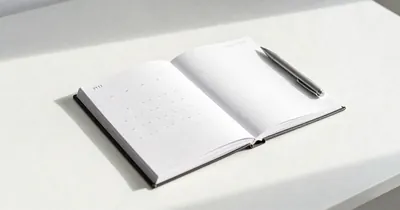
A dedicated ADHD planner can help with this. The Wilkii ADHD Planner (around $32 for a 90-day undated version) is designed specifically for neurodivergent brains. Instead of rigid daily schedules, it uses priority-based layouts, emotion check-ins, and flexible task lists that accommodate how ADHD actually works. The undated format means skipping a day does not create a visible record of "failure" - you just pick up where you left off.
Other external scaffolding strategies include:
- Whiteboards in every room where tasks happen - visual, erasable, impossible to lose
- Phone alarms with specific labels - not "meeting" but "STOP what you are doing and go to room 204"
- Single-task workspaces - one browser tab, one document, one purpose
Visual Timers and Time Blindness
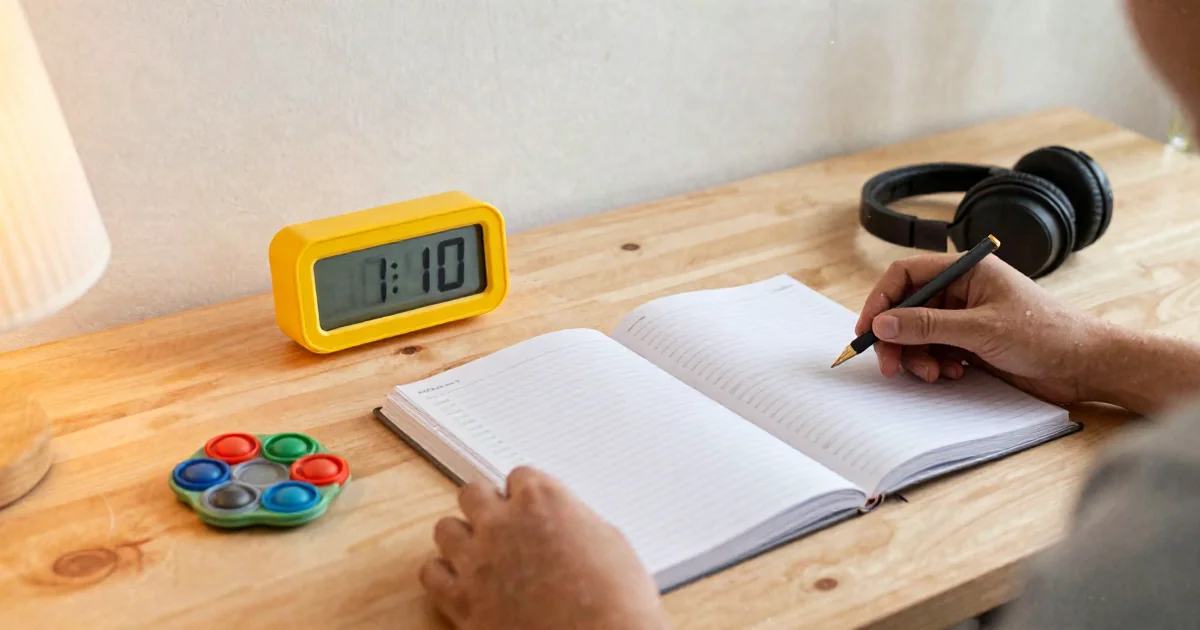
Time blindness is not about being careless with time. It is a neurological difference in how the brain processes temporal information. Abstract time - the kind represented by digital clocks - is difficult for many ADHD brains to internalize.
Visual timers solve this by making the passage of time concrete and visible. The Time Timer Original 8-inch (approximately $35-45) uses a red disk that shrinks as time passes. There is no need to interpret numbers or do mental math. You can see at a glance how much time remains.
Research from the University of Gothenburg found that visual time aids improved task completion rates in ADHD participants by 22% compared to standard digital timers. The key mechanism is that it converts abstract time into spatial information, which ADHD brains process more naturally.
Practical applications include:
- Set a 25-minute visual timer for focused work, then take a break when the disk disappears
- Use it during transition periods ("you have 10 minutes before we leave" becomes visible)
- Place it next to tasks you tend to hyperfocus on to prevent time from vanishing entirely
Body Doubling and Accountability Anchors
Body doubling - working alongside another person, even silently - is one of the most consistently reported ADHD strategies. Studies in Frontiers in Psychology suggest that social presence activates attention regulation networks that are underactive in ADHD.
You do not need a formal accountability partner. Options include:
- Virtual co-working sessions through platforms like Focusmate
- Working in coffee shops or libraries where ambient social presence provides gentle structure
- Video calls with a friend where both people work silently on their own tasks
The mechanism is not motivation through pressure. It is that another person's presence provides just enough external stimulation to keep the ADHD brain engaged without overwhelming it.
Reward Bridging and Fidget Tools
ADHD brains have lower baseline dopamine activity, which means the gap between starting a boring task and completing it feels enormous. Reward bridging closes that gap by adding small, immediate sensory rewards to otherwise unstimulating work.
This is where fidget tools become genuinely functional rather than gimmicky. The ONO Roller Aluminum (around $25-35) is a professional-looking fidget tool made from machined aluminum. It provides tactile stimulation during calls, reading, or desk work without the distraction of phone-based fidgeting. Research on fidget tools and ADHD, published in the Journal of Abnormal Child Psychology, found that physical movement during cognitive tasks improved attention and working memory performance in ADHD participants.
Other reward bridging strategies:
- Pair boring tasks with preferred sensory input - specific music playlists, a favorite drink, or a textured pen
- Break large tasks into micro-completions - check off five small items instead of one large one
- Use "temptation bundling" - only listen to a favorite podcast while doing household tasks
Building Your Own ADHD-Friendly System
No single system works for every ADHD brain. The goal is to identify which executive function gaps affect you most and build external supports around those specific weaknesses.
A practical starting point:
- Track your failure points for one week - where do tasks stall? Starting? Switching? Finishing?
- Add one external support targeting your most common failure point
- Evaluate after two weeks - does this tool reduce friction or add complexity?
- Iterate - swap, adjust, or layer additional supports based on results
The best ADHD productivity system is one you actually use. Perfection is irrelevant. Consistency through low-friction design matters far more than optimization.
This content is for educational purposes only. Productivity strategies should be adapted to your individual needs and circumstances. If you suspect you have ADHD, consult a qualified healthcare professional for evaluation and guidance.
TopicNest
Contributing writer at TopicNest covering productivity and related topics. Passionate about making complex subjects accessible to everyone.