Table of Contents
PKM in 2026: Obsidian, Notion, or a Second Brain That Actually Works
Most personal knowledge management systems fail quietly. Notes accumulate, folders multiply, and retrieval becomes unreliable. The problem is rarely the tool - it is the absence of a structure that connects capture to actual use.
The average knowledge worker creates approximately 2.5 GB of personal information annually - notes, bookmarks, documents, research - but retrieves less than 10% of what they store. The gap between collection and use is where most PKM systems collapse.
Why Most PKM Systems Collapse
The capture habit is easy to build. The retrieval system is not.
People start PKM systems with enthusiasm, add hundreds of notes in the first few months, and then find that the system has become another source of clutter rather than a resource they actually use. The notes are in there somewhere, but finding the right one at the right moment requires either a perfect memory for where things were filed or a search system good enough to compensate.
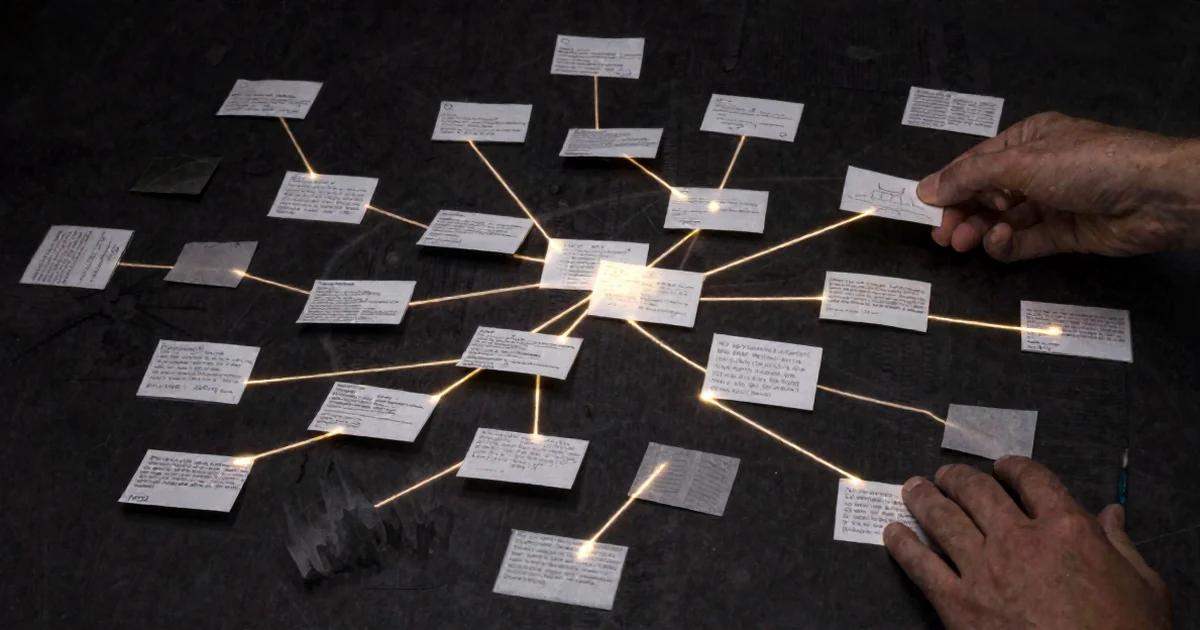
The second common failure mode is treating PKM as a filing cabinet rather than a thinking tool. Notes collected but never processed do not improve thinking - they just store information. The Zettelkasten method developed by German sociologist Niklas Luhmann is worth examining here: Luhmann produced over 70 books and papers using a system of atomic, heavily linked notes. Each note contained one idea and was explicitly connected to related notes. This is fundamentally different from saving articles to a folder and assuming they will be useful later.
Obsidian vs Notion: Who Each Tool Is For
By 2025, Obsidian had grown to over 1 million active users, driven by a local-first, privacy-focused movement. Notion had reached over 30 million users, dominant as both a personal wiki and team collaboration tool. Both are capable PKM tools, but they make different tradeoffs.
Obsidian stores notes as plain markdown files on your device. There is no proprietary format, no lock-in, and no dependency on a company's continued operation. The graph view - showing connections between linked notes - is genuinely useful for seeing relationships across a large note collection. The plugin ecosystem is extensive, and AI integration via Obsidian Copilot plugins allows surfacing connections that might otherwise go unnoticed.
Obsidian suits people who want full control over their data, work primarily alone, and are willing to invest time in configuration. It has a steeper initial learning curve than Notion.
Notion is more immediately accessible. Pages look good out of the box, databases are powerful for structured information, and collaboration features make it useful for shared knowledge bases. Notion AI can summarize pages, generate content, and answer questions about your notes.
Notion suits people who want a clean interface without setup time, need to collaborate with others, or use their PKM system for project management alongside note-taking. The trade-off is proprietary storage format and a dependence on Notion's servers.
For most individuals starting from scratch in 2026, Notion is the lower-friction entry point. For anyone who has tried Notion and found it too database-heavy for personal notes, Obsidian is the natural alternative.
The PARA Framework: Applied to Either Tool
Tiago Forte's PARA method has become the most widely adopted PKM framework in 2025-2026. PARA stands for Projects, Areas, Resources, and Archives.
Projects are short-term efforts with a defined outcome and end date. Writing an article, preparing a presentation, completing a course. Projects are active and should be prominently accessible.
Areas are ongoing responsibilities with no end date - health, finances, a professional role, a relationship. Areas require regular attention but do not have a finish line.
Resources are reference material organized by topic - things you might want to consult in the future. Research on a subject, notes from books, reference documents.
Archives contain everything from the other three categories that is no longer active. Completed projects, discontinued responsibilities, reference material no longer needed.
PARA works in both Obsidian and Notion because it is a structure, not a feature. In Notion, it maps naturally to a top-level page hierarchy. In Obsidian, it maps to a folder structure. The key principle is that organization should follow action: if you cannot tell immediately which category a note belongs to, the note probably needs more processing before filing.
The Capture Habit
Capture without processing is one of the most common PKM failures. Bookmarking an article is not the same as taking a note on what you learned from it. Saving a quote is not the same as writing down why it was significant.
Research comparing handwritten and typed note-taking consistently shows that handwriting improves conceptual recall by around 23%, but digital notes win on searchability and longevity. The underlying finding is that the act of processing and reformulating information in your own words matters more than the medium.
A practical capture habit does not need to be elaborate. For most people, a simple inbox - a single place where everything captured goes before being processed - is more useful than an elaborate tagging system. The inbox gets cleared at a set interval (daily or weekly), and items are either discarded, processed into a note, or turned into a task.
What AI in PKM Actually Does Well in 2026
AI integration in both Obsidian (via plugins) and Notion (via Notion AI) has improved significantly. The most genuinely useful capabilities are search and connection surfacing.
Semantic search - finding notes by meaning rather than exact keyword match - makes a large note collection much more retrievable. Asking a question in natural language and getting relevant notes as results solves one of the core retrieval problems.
Automatic connection suggestions - AI identifying relationships between notes you might have missed - can surface useful links in a large Zettelkasten-style system. This is one area where AI adds value that would be difficult to replicate manually at scale.
AI generation of notes from captures (summaries, structured extracts from articles) is more mixed. The summaries are accurate but shallow. The most valuable notes in any PKM system are the ones that contain your own thinking and synthesis, not AI-generated summaries of what others have written.
This content is for educational purposes only. Productivity strategies should be adapted to your individual needs and circumstances.
Explore more productivity strategies - /productivity
TopicNest
Contributing writer at TopicNest covering productivity and related topics. Passionate about making complex subjects accessible to everyone.