Table of Contents
Carry-On Only Travel: The Complete Packing System for 2026
Checked luggage has become one of the more predictable ways to inflate travel costs. European airlines charge EUR 25-75 per bag per flight, and the fees apply in both directions. For a return trip with one checked bag, that is EUR 50-150 gone before the trip starts - more than a night's accommodation in many destinations.
Beyond the cost, checked bags add time at both ends of the journey: check-in queues, baggage claim, and the anxiety of delayed or misrouted luggage. Carry-on only travel removes all of these.
The Cost Calculation
The average checked baggage fee across European low-cost carriers is EUR 25-65 per bag per flight. Ryanair charges up to EUR 75 for bags added at the airport rather than online. For frequent travelers, the annual cost of checked luggage is substantial.
The IATA carry-on maximum for most European airlines is 55x40x20 cm, with a weight limit of 10 kg. This is the standard around which a carry-on system needs to be built.
Note that Ryanair specifically restricts the free small bag (40x20x25 cm) for basic fare passengers - a full carry-on requires paying for Priority boarding or a bag fee. Checking airline-specific restrictions before each trip is essential, as they vary and change.
Clothing Math: How Many Items for 1-3 Weeks
The biggest barrier to carry-on only travel is usually clothing anxiety: the belief that a 2-week trip requires 2 weeks of clothes. In practice, a laundry strategy collapses the clothing requirement dramatically.
For a 1-week trip with access to laundry mid-week, or a 2-week trip with laundry once per week, a working wardrobe of 3-4 tops, 2 bottoms, 4-5 pairs of socks and underwear, and one layer for warmth is sufficient. The math depends entirely on how often you are willing to do laundry.
Accommodations with laundry facilities include most Airbnbs, many hostels, and a growing number of hotels. Laundromats are accessible in virtually every urban destination. Hand-washing in a sink with travel soap is viable for lightweight items and can refresh a piece that needs another day's wear.
Fabric Choice: Why Merino Changes the Calculation
Merino wool is the most significant factor in making carry-on only travel comfortable rather than limiting. Merino resists odors for 2-4 days of wear due to the fiber's natural antimicrobial properties, which means the same t-shirt can be worn multiple times between washes without being unwearable.
This reduces the clothing needed by 50-60% compared to standard cotton, which needs washing after one or two wears. A merino t-shirt worn three times between washes replaces three cotton t-shirts in a bag.
Merino also dries quickly, packs compactly, and handles a wide temperature range - useful for trips that span different climates. The trade-off is cost: quality merino tops typically cost EUR 50-100 compared to EUR 15-25 for cotton equivalents. For frequent travelers, the investment pays off rapidly through reduced checked bag fees.
Synthetic fabrics (polyester, nylon blends) are an alternative for performance-focused packing - they dry faster than merino and cost less, but they do not match merino's odor resistance.
The Toiletry Problem
Liquids are the main carry-on constraint beyond clothing. The EU 100ml liquid rule applies to all liquids, gels, and aerosols in carry-on bags, and the 1-litre clear bag restriction limits total liquid volume significantly.
Solid toiletries eliminate the restriction entirely. Solid shampoo bars, conditioner bars, and solid soap replace their liquid equivalents without volume limits. They also last longer per gram: a solid shampoo bar equivalent to a 250ml bottle of liquid shampoo typically weighs 65-80g, fitting in any bag without liquid rules.
For items where solid alternatives are not viable or desirable, two strategies work: purchasing at the destination (shampoo and conditioner are available everywhere), or using accommodation-provided products for shorter trips.
Grocery stores and pharmacies at the destination are also the most cost-effective source for sunscreen, hand cream, and similar items that take up disproportionate liquid allowance.
Bag Choice: 20L vs 30L vs 40L
Bag size determines the carrying capacity, and different sizes suit different trip lengths and travel styles.
A 20-25L daypack-style bag works for weekend trips and ultra-minimalist packers on longer trips. It fits under most aircraft seats, which is useful on flights where overhead bins fill early.
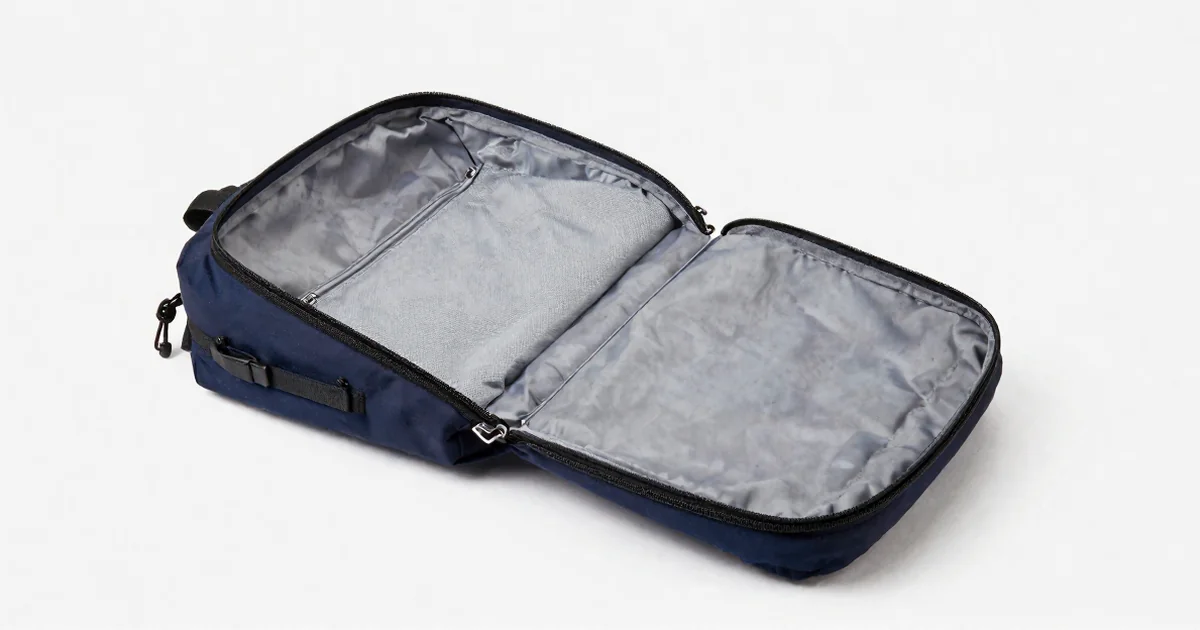
A 30-35L bag hits the balance point for most carry-on only travelers - large enough for 7-14 days with the right clothing choices, still within most airline size limits, and manageable for full day city walking without checking it.
A 40L bag fits within most major airline carry-on dimensions (55x40x20 cm maximum is 44 litres in volume) and carries enough for 3+ weeks with a laundry strategy. The r/onebag community - 1.2 million members who have collectively tested most major bags and systems - broadly converges on the 35-40L range as the practical maximum for indefinite travel.
Backpack-style bags work better than wheeled carry-ons for destinations with cobblestones, public transit stairs, or significant walking.
Packing Organization
Packing cubes compress clothing volume by 20-30% compared to loose packing, and more importantly they make retrieval and repacking efficient. A typical system uses one cube for tops, one for bottoms, one for electronics and cables, and a toiletry bag.
Rolling clothes rather than folding them reduces volume and wrinkles. Compression cubes with zip-down compression add further volume reduction but are heavier and more expensive.
The Airport Test
Before committing to a bag for a specific trip, verify the airline's exact size requirements. Ryanair, easyJet, Wizz Air, and Vueling all have slightly different size limits and different rules for basic fare holders. Some airlines have begun using size gauges at gates, and bags that are marginal in size are being checked at the gate with fees.
The test is simple: put the packed bag in the airline's published size gauge dimensions before the trip. If it fits with the contents you are actually bringing, it will fit at the airport.
For pre-booking activities and tours at your destination - where a light, carry-on-friendly bag makes mobility much easier - klook provides options across most major travel destinations.
Travel information changes frequently. Verify details before booking. Travel involves risk.
Explore more travel guides - /travel
TopicNest
Contributing writer at TopicNest covering travel and related topics. Passionate about making complex subjects accessible to everyone.